
Podcast Discoverability
Episodes from PodHood about Podcast Discoverability.
2 episodes
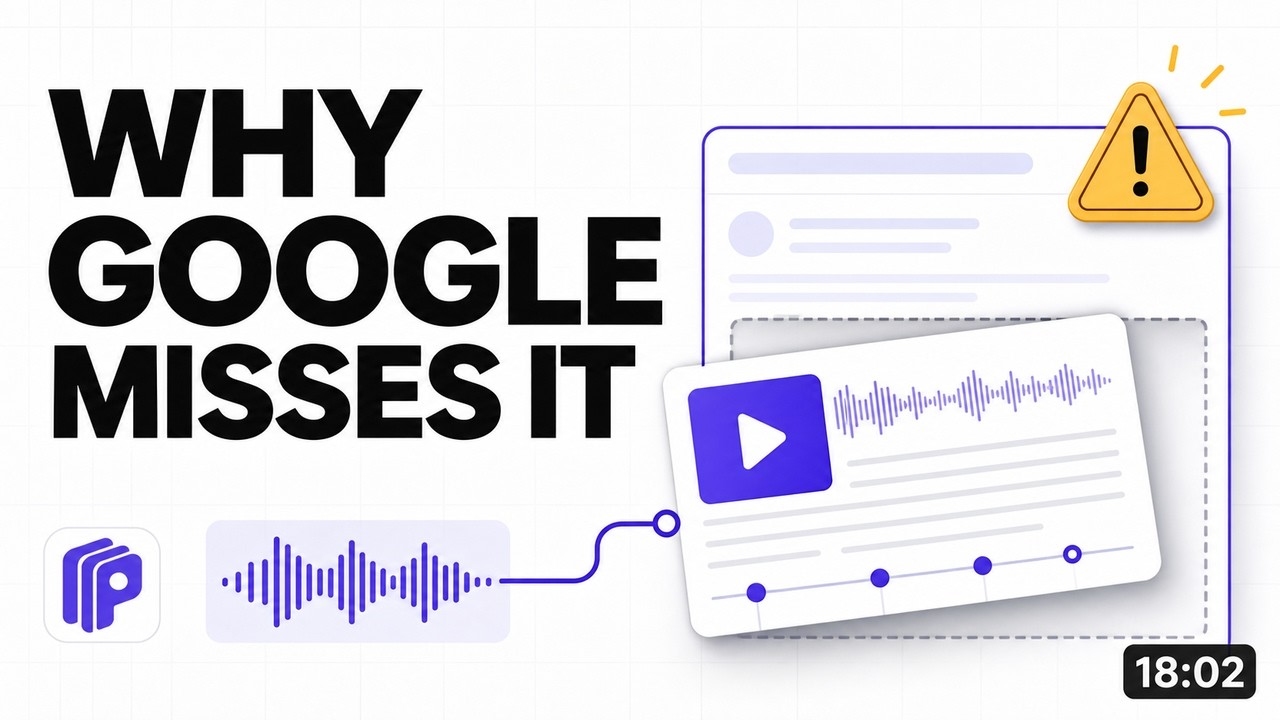
Podcast SEO: Why Your Episodes Don't Show Up on Google
Aug 4, 2026 · 7:39
RSS distribution alone leaves podcast episodes invisible on Google; PodHood’s per-episode pages with visible transcript, chapters, speakers, and exact moments make them discoverable. Workflow: crawler discovers a URL; Google renders visible content, decides page and video indexing; ranking systems match the page to queries. Page needs prominent player, unique title, speaker-attributed transcript, VideoObject data, stable thumbnail, canonical URL, sitemap, internal links — shown on PodHood’s latent space page. Closing audit: permanent episode URL, player as primary content, unique title, visible summary/transcript, matching structured data, crawler paths, Search Console checks. Structured data and crawlable pages create eligibility, but Google decides what to crawl, index, rank, and display.

How to Get Your Podcast Cited by ChatGPT and Claude
Aug 3, 2026 · 8:21
This episode explains how podcasters can make their episodes retrievable and citable by ChatGPT, Claude, and Perplexity, arguing that structured transcript pages and an optional MCP connector—not just uploading audio—determine whether an AI cites a podcast. It walks through six core ingredients of a citable source: a permanent URL, visible transcript, speaker attribution, chapters, exact timestamps, and surrounding context. It contrasts the public web road (publishing a watch page with metadata and sitemap) with the connected road (adding PodHood as an MCP server to Claude, ChatGPT, or Cursor for direct transcript search). Using a real PodHood library from Latent Space, it shows how searches find specific claims with timestamps, not just episode titles. It also gives a five-step audit: choose one audience question, publish a page, create exact-second links, make it discoverable, and test both roads. The speaker stresses that PodHood can create eligibility, but cannot guarantee Google indexing or AI citation.
Powered by PodHood